

Fractured Modernity and Polyphonic Form
Historical Trauma, Intimacy, and Metapoetics in Zoltán Böszörményi’s Ripped Apart
By Walter Fromm
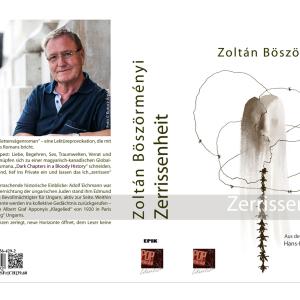
Zoltán Böszörményi’s novel Ripped Apart occupies a distinctive position within contemporary European prose by staging the condition of fracture as both thematic focus and structural principle. Rather than narrating a linear plot driven toward resolution, the novel constructs what might be termed a poetics of rupture: personal relationships, historical memory, and epistemological frameworks alike appear destabilized, exposed, and internally divided. The titular “severance” thus functions not as metaphor alone but as ontological diagnosis.
At its core, the novel interweaves three principal axes: the erosion of intimate relationships in late modernity; the persistent afterlife of twentieth-century historical trauma; and a self-reflexive interrogation of literature’s role in an age of political and moral disorientation. These axes do not converge into synthesis; instead, they remain in tension, producing a polyphonic narrative architecture that resists hierarchical ordering.
Intimacy Under Late Modern Conditions
The Toronto-based narrative strand centers on Melanie V. Templeton, a psychologist, and her husband Richard Vaughn, a lawyer whose marriage has ossified into emotional and ideological estrangement. Their extramarital entanglements – Melanie with Paul Harding and Kenneth White, Richard with the student Susan Lang – initially suggest the conventions of the contemporary psychological novel. However, Böszörményi avoids reducing these relationships to sociological case studies or moral cautionary tales.
Instead, intimacy appears as structurally unstable. Desire does not generate liberation but further fragmentation. Ethical categories—loyalty, betrayal, autonomy – prove insufficient to stabilize the characters’ experience. Particularly significant is the figure of Susan Lang, whose traumatic history (a gang rape experienced in ambivalent corporeal terms) unsettles simplistic victim-perpetrator binaries. The novel refuses therapeutic closure. Trauma is not narratively redeemed but remains as psychic residue.
In this respect, Ripped Apart participates in a broader post-Freudian literary discourse in which subjectivity is understood not as coherent interiority but as a field of contradictory impulses and sedimented affects.
The Writer as Figure of Epistemic Crisis
A second narrative axis follows Thomas Larringen, a Canadian novelist suffering from creative paralysis and from what he perceives as literature’s diminishing relevance. His marriage to Eva, a pragmatic and economically successful real estate agent of Hungarian descent, dramatizes the tension between symbolic production and material functionality in late capitalist modernity.
Thomas’s eventual artistic breakthrough does not culminate in triumphalist self-affirmation. Instead, authorship emerges as precarious labor – an activity marked by self-doubt, exposure, and existential risk. The novel thereby engages in metapoetic reflection: literature is not positioned as redemptive authority but as fragile intervention within a reality that exceeds narrative containment.
Thomas’s diary fragments embedded in the text underscore this reflexive dimension. The novel comments upon its own narrative procedures, foregrounding writing as process rather than product. Such self-reflexivity aligns Severance with postmodern narrative traditions, yet Böszörményi’s use of it remains ethically grounded rather than ironic.
Historical Trauma as Persistent Structure
Perhaps the most distinctive feature of the novel is its integration of documentary material addressing Hungary’s twentieth-century history, particularly the trauma of the Treaty of Trianon and the Holocaust. These historical insertions – explicitly marked as “Dark Chapters in a Bloody History” – interrupt the present-tense narrative, functioning not as contextual backdrop but as disruptive force.
The Treaty of Trianon is presented not merely as geopolitical event but as intergenerational psychic wound. The text suggests that collective trauma persists in diffuse affective registers: irritability, overcompensation, identity anxiety. By embedding historical speeches and archival documents directly into the narrative, Böszörményi destabilizes the boundary between fiction and historiography.
The portrayal of Edmund Veesenmayer, Hitler’s plenipotentiary in Hungary, exemplifies this strategy. Rather than dramatizing evil through sensationalism, the novel foregrounds the bureaucratic and intellectual composure of administrative violence. The cold precision of archival language becomes itself a mode of narrative exposure.
This documentary technique situates Ripped Apart within traditions of historiographic metafiction while maintaining a seriousness of ethical engagement that distances it from postmodern relativism.
Dream, Fluid Identity, and Epistemological Uncertainty
The Paris episodes, centered on Kenneth White and Fredy Bloom, introduce a further destabilization of narrative realism. Here, dream sequences and altered states of perception function not as ornamental surrealism but as epistemological challenge. Identity becomes fluid, performative, and unstable; sexuality resists categorization; reality loses ontological solidity.
Dream logic emerges as alternative cognition. In a fractured world, coherence is no longer assumed but interrogated. The novel thus aligns with philosophical traditions – ranging from phenomenology to post-structuralism – that question the stability of subject-object relations.
Polyphony and Rhizomatic Structure
Formally, Severance employs a polyphonic structure incorporating dialogue, interior monologue, epistolary fragments, diary entries, documentary excerpts, and philosophical reflection. This multiplicity resists centralized narrative authority. No single perspective achieves dominance.
The intertextual range – extending from classical philosophy to modern theoretical discourse—creates what may be described, following Deleuze and Guattari, as a rhizomatic architecture. Knowledge is not vertically ordered but laterally proliferating.
Such structural heterogeneity constitutes both aesthetic risk and interpretive demand. The novel requires active, critical readership. Yet its complexity serves thematic coherence: fragmentation at the level of content is mirrored by fragmentation at the level of form.
Conclusion: Literature in the Age of Fracture
Ripped Apart does not offer reconciliation. It neither restores moral certainty nor re-establishes narrative unity. Instead, it enacts fracture as experiential condition while maintaining faith in literature’s capacity for articulation.
In a cultural moment often characterized by informational overload and ideological simplification, Böszörményi’s novel insists on complexity. It holds together intimacy and geopolitics, trauma and desire, documentation and imagination without dissolving their tensions.
Thus, Ripped Apart may be read as a significant contribution to contemporary European prose: a work that confronts fractured modernity not by smoothing its ruptures, but by rendering them structurally visible.
Livres téléchargeables gratuitement

Dernières nouvelles

Commentaires

Commentaires
Commentaires


Publications

Poème
Mes lecteurs ont écrit

Un nouvel esclavage qui ne dit pas la réalité
le nouvel eldorado en europe s’avère être un nouvel esclavage qui ne dit pas la réalité
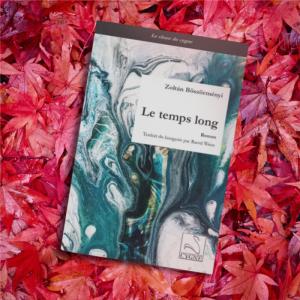
Le Temps long
Patphil
Le Temps long
ILy a quelques années , faisant mes courses, je suis tombé sur deux ukrainiens( 35/40 ans) , travaillant pour une entreprise anglaise , en France !…. Nous avons parlé du pays , de la famille , j’ai vite compris que ces deux pauvres types n’étaient pas là de leur plein gré , que c’était des gagne petit et que leur sort s’apparentait à une forme d’esclavage , des vies brisées , dont seule profitait l’entreprise anglaise
Le Temps long
Voronine
Ce sont toujours les enfants qui paient les errances des adultes…
Ce sont toujours les enfants qui paient les errances des adultes…que ce soit dans les guerres ou l’immigration économique qui voit arriver des bateaux remplis à craquer mais avec peu de femmes et enfants. Ces hommes qui fuient leur pays laissent leur progéniture se débrouiller et le regroupement familial…..La plupart sont d’obédience religieuse islamique radicale alors les droits des femmes ne sont pas la priorité et les enfants sont les victimes collatérales de ces migrations débordantes.
Le Temps long
Jotglars 66
Un grand roman !
La dernière fois, en revenant de la Porte de Fer et de Krassó-Szörény en octobre, j'ai reçu le dernier livre de Zoltán, While I Think I Exist, à la Maison actuelle.
Je l'ai lu avec beaucoup d'intérêt, littéralement jusqu'au bout, j'avais du mal à le poser.
Une fois de plus, je remercie Zoltán et Jelen Publishers pour ce livre. J'ai eu l'impression de lire une histoire imprimée en ligne. Un grand roman !
Avec toute mon amitié,
Gábor

À propos de Regal
Un bon roman offre des possibilités infinies d'interprétation et de lecture. Le Regal est un tel roman. L'une des citations de Kinga Lázár donne particulièrement à réfléchir. "Comment me comporterais-je à leur place ?" La question est posée par Tamás, le personnage principal. Oui, cela vaut la peine d'aborder les personnages de ce point de vue et de se poser la question : Comment me comporterais-je à leur place ?